

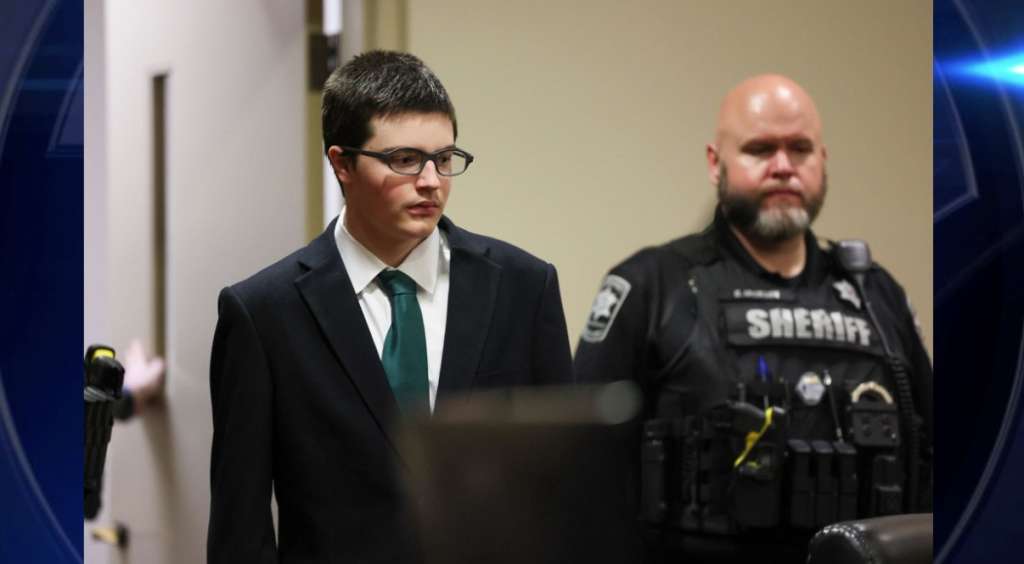
(CNN) — A Georgia court heard testimony that shed new light on a possible motive for Colt Gray, the teen who fatally shot four people at Apalachee High School in 2024, including evidence of his obsession with previous mass shootings and his desire for infamy.
Prosecutors and defense attorneys spent the second day of the sentencing hearing Monday debating whether Colt, 16, can ever be rehabilitated, as the court weighs whether to allow the option of parole with his expected life sentence.
The hearing comes nearly two years after the attack, the deadliest school shooting in Georgia history. Colt, who was just 14 at the time, took an AR-15-style rifle to school and fatally shot teachers Richard Aspinwall and Cristina Irimie and students Mason Schermerhorn and Christian Angulo, nine others were also injured.
Colt pleaded guilty Friday to 55 charges, including four counts of murder. In court, victims’ families and shooting survivors spoke about their physical and emotional scars.
The hearing is expected to conclude Tuesday, when the defense has indicated in court filings that it may call its two final witnesses: Colt’s grandmother and another mental health expert. Colt will have an opportunity to address the court before Judge Nicholas Primm decides whether to sentence the him to life with or without parole.
New clues around shooter’s motive
In messages read aloud in court Monday, Colt wrote about his longing for fame and his obsession with Nikolas Cruz, the Parkland school shooter who killed 17 students and teachers in 2018.
“(I) wanna make history to put it short,” Colt wrote on the messaging platform Discord more than a year before the shooting. “I want people to remember the pain I caused and research me for hours.”
“My love for Nik has formed into something in which I can find no other resort that can prove my love and affection towards him,” he wrote in another message days before the shooting.
It was “especially painful to learn that (Colt) idolized the murderer who attacked our children and spouses and used that tragedy as inspiration,” said Tony Montalto, president of Stand with Parkland — an advocacy group founded by families of the 2018 Marjory Stoneman Douglas High School shooting — said in a statement to CNN. Montalto’s daughter was killed in the Parkland attack.
Dr. Kevin Richards, a forensic psychologist, testified for the defense Monday about Colt’s mental health issues. He said the teen’s paranoia, depression and anxiety were exacerbated by neglect and abuse at home and an online fixation with mass shooters.
“He was a lonely, dysfunctional kid who was anxious, paranoid, depressed and immersed in this highly dysfunctional world with these people who were obsessed with folks who had done school shootings,” Richards said.
Ashley Gilleland, an investigator with the Barrow County District Attorney’s Office, testified Monday about writings in Colt’s journal and statements to police that were inspired by other mass shootings, including the 2012 Aurora, Colorado, movie theater massacre; the Sandy Hook Elementary School shooting; and the 2018 Parkland attack.
On Friday, the courtroom heard recordings of Colt’s interview with investigators less than an hour after the shooting.
Sobbing and gasping, he apologized and offered paranoid, hallucinatory explanations for his actions, saying he believed teachers were plotting against him. He also told investigators he believed he should be in a mental health facility.
Richards reviewed case files and interviewed Colt for about 15 hours for his analysis, he said. He testified Monday that Colt could improve with proper interventions and medication.
But on cross-examination, Richards said Colt had exaggerated his mental health symptoms and made things up to try to get a more serious diagnosis. Colt did not show signs of insanity, schizophrenia or bipolar disorder, Richards said.
“My evaluation didn’t reveal any actual mania or any diagnosis of schizophrenia,” he said. “They can talk about it until the cows come home, but there was no evidence for it.”
Testimony from Colt’s grandmother, who may appear Tuesday, could provide additional insight into the boy’s upbringing and family life before the judge determines the sentence.
Colt’s father, Colin Gray, was found guilty of murder and manslaughter charges in March for purchasing the firearm for his son and keeping it unsecured despite warnings that Colt was a danger to others.
The father’s trial revealed the extent of Colt’s tumultuous childhood. His mother struggled with drug and alcohol addiction, and the family moved repeatedly. Family members spoke about Colt’s deteriorating mental health, and school records show he was repeatedly absent from class, including missing his entire eighth-grade year.
Colin Gray faces decades in prison, and his sentencing begins Thursday.
The next day, just five miles south of the Barrow County Courthouse, students will return to Apalachee High School for the first day of the new school year.
Lasting impacts of the attack
Friday’s sentencing hearing belonged to the victims. One after another, family members and survivors stood before the court, describing who they were before September 4, 2024, and who they have become since.
“I started to hate myself because I couldn’t truly live anymore, because I let you take every piece of joy I had away from me,” said Nautica Walton, who was in ninth grade when she was shot in the leg.
“I hate everything about you,” she told Colt. “I hate the scars you left on my body. I hate that you took innocent lives in front of innocent people. Most of all, I hate that I let you live in my mind.”
Others acknowledged Colt’s difficult childhood, as revealed during his father’s trial, while making clear it could never justify his actions.
“Two things can be true at the same time,” said Sarah Beaver, the mother of shooting survivor Jaxson Beaver. “He was a child who was failed. He was also the person who failed countless innocent children and their families.”
“The defendant’s family will still get to see their son, talk to him and know he is breathing,” said Ismael Angulo Jr., the oldest sibling of victim Christian Angulo. “My mother (and) my father don’t get that privilege. The only way to visit Christian now is by standing over his grave.”
He added: “There is no fairness in that reality.”
CNN’S Eric Levenson, Isabel Rosales, Sarah Hutter, Andy Rose, Devon M. Sayers, Alaa Elassar and Rebekah Riess contributed to this report.
The-CNN-Wire™ & © 2026 Cable News Network, Inc., a Time Warner Company. All rights reserved.